If your rankings have been doing the cha-cha this month, you're not imagining it.
October 2026 has been one of those months. Rank trackers lighting up red, SEO Twitter (sorry, X) full of screenshots, clients sending me messages with way too many exclamation marks. And Google? Officially, nothing to see here. No confirmed update since the spam update wrapped up on 8 October.
I run Spresso Studio, a small agency that does SEO and paid ads for businesses across a bunch of industries. So I get to see this stuff happen across a lot of sites at once, not just one. Here's what I'm actually seeing, what I think is going on, and what I do (and don't do) when rankings start moving around.
So what actually happened in October?
Quick recap, because the timeline matters here:
- 24 September to 8 October: Google's September 2026 spam update rolls out. That one was confirmed by Google.
- 16 October: First round of tracker spikes and chatter after the spam update finished.
- 20 and 21 October: Volatility heats up again.
- 24 October: Another spike.
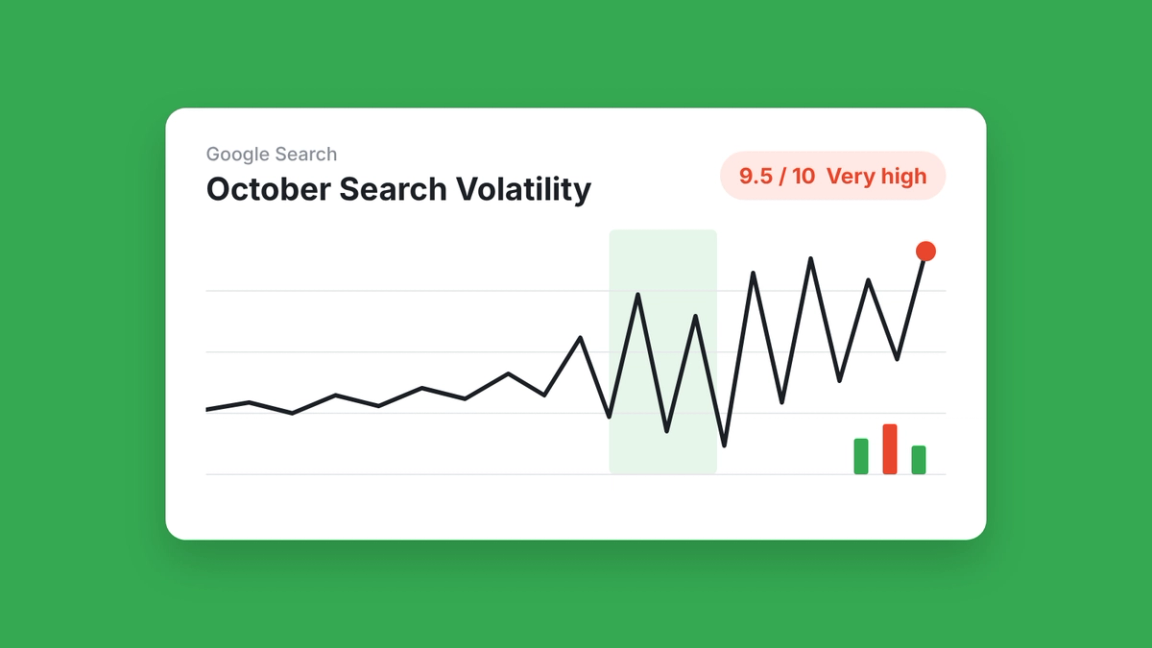
- 27 October: The big one. Semrush Sensor hit 9.5 out of 10, which is basically "something is very much happening" territory.
- 1 November: Still no open ranking incident on Google's Search Status Dashboard.
So yeah. Lots of movement, zero official word. Classic Google.
Is there a Google update right now?
Honestly, the fastest way to check is to look at a volatility tracker instead of guessing. I keep an eye on Semrush Sensor. Here's what it looked like when I wrote this:
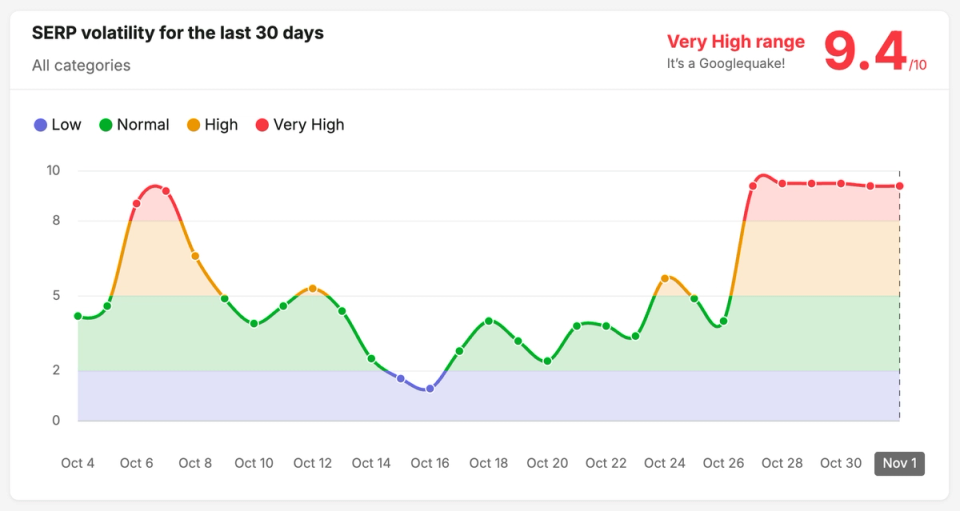
The way I read it: anything above 8 means Google's results are shuffling a lot more than usual. But a high score on its own doesn't tell you why. It just tells you you're not crazy.
Then I cross-check with Google's Search Status Dashboard. If there's an update listed there, cool, we know what we're dealing with. If not (like now), it's either an unconfirmed update, a test, or Google adjusting how it shows results. Which brings me to what I'm actually seeing.
What I'm seeing in our clients' data
Ok, here's the plot twist. While half the internet was panicking about drops, most of the sites I look after actually went up.
We work with businesses in bookkeeping, flooring, beauty, electrical, mobile physio and NDIS disability support. I pulled three months of their Search Console data and the pattern is pretty consistent.
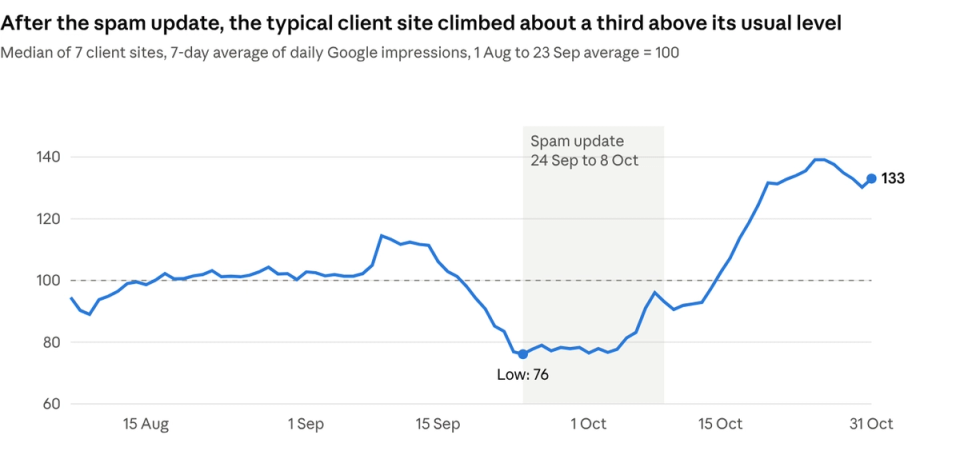
While the spam update was rolling out, impressions actually dipped. Then from around 10 October they started climbing again, and by late October the typical site was sitting roughly a third above where it was in August and September.
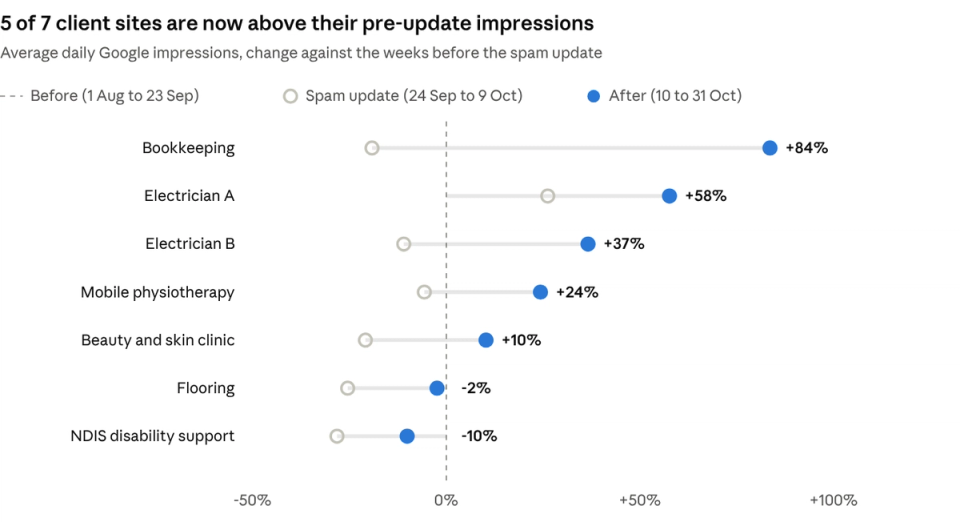
Not everyone moved by the same amount though. Bookkeeping and one of the electricians jumped the most. Flooring and the NDIS provider mostly just won back what they lost during the update. And to be fair, clicks haven't really moved yet. More impressions doesn't instantly mean more phone calls, that part usually lags a bit.
That timing is interesting. It's two or three days after the spam update finished. My read is that when Google cleans out some of the spammy stuff, legit local businesses that were doing things properly get a bit more room. Can I prove that? No. But the timing lines up a little too neatly to ignore.
Then there's our own site.
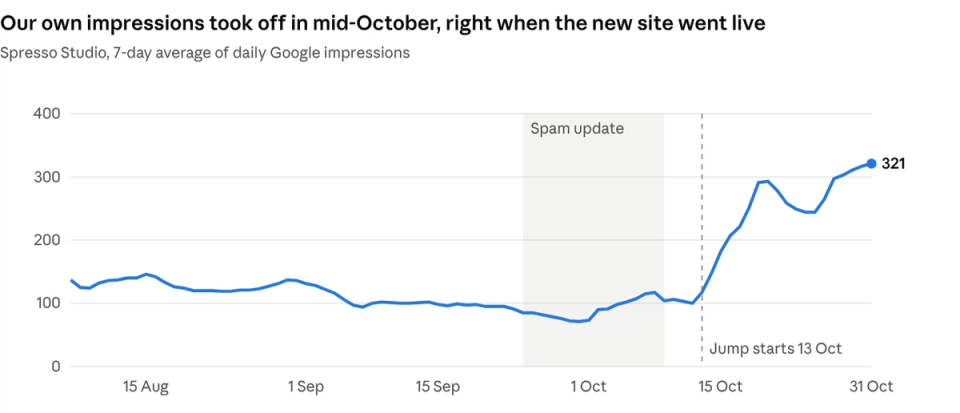
Spresso's impressions roughly tripled from mid-October. Great, right? Except... we launched a full website redesign at basically the same time. So I genuinely can't tell you how much of that is Google and how much is the new site. And I think that's worth saying out loud, because a lot of SEO "case studies" conveniently skip the part where three things changed at once.
Which is kind of the whole point of this post. Correlation is not a diagnosis. Rankings moving during a volatile month doesn't automatically mean the volatility caused it.
My take: Google's rolling out unconfirmed updates (again)
I don't think October is random noise. My honest guess is that Google is pushing smaller, unconfirmed updates, like it's done plenty of times before.
People forget this, but Google tweaks search constantly. It's said it makes thousands of changes a year. Only a handful get a name and an announcement. The rest just... happen, and we all see it in our trackers before anyone at Google says a word (if they ever do).
A couple of other things are probably adding to the noise too:
- AI Overviews keep changing. Google's testing new layouts, and more searches now show an AI answer up top. That shifts what people click, even if your actual position barely moved.
- Tracking tools are having a rough time. Google's made changes over the past year that affect how SEO tools collect ranking data, so some of the "spikes" may be partly a tool problem, not a Google problem.
A lot of people in the industry are also expecting a core update before the holidays. Maybe some of this is Google testing ahead of that. Maybe not. Nobody outside Google actually knows, and anyone who tells you otherwise with total confidence is guessing too.
Why did my rankings drop? The 3-step check I actually use
When a client messages me "our rankings dropped!!", this is what we do. It stops us from making a bad situation worse.
1. Look at the pages that dropped, and what changed on them
Not the whole site. The specific pages losing positions. Then the first question: did we change anything on them recently? New copy, a template update, a plugin, a redirect, anything. And does the timing of that change line up with the drop, or with a Google update? Half the time the answer is sitting right there in the change log. Honestly, it's step one of every SEO audit we do.
2. Check whether Google actually launched an update, and if it's relevant
If there's a confirmed update, read what it's targeting. Spam? Helpful content? Reviews? Then ask honestly: does anything on this page fall into that bucket?
- If yes, we fix that specific thing.
- If no, we look at what could be better on the page. But we don't make major changes unless the page is actually breaking a guideline or clearly missing something the update is going after.
That second part is the important bit. "Could be improved" and "needs to be rebuilt right now" are very different things.
3. Monitor for a few weeks before doing anything drastic
Then we watch. Rankings during volatility bounce around a lot, and pages often come back on their own once things settle. We track the affected pages over a few weeks and only escalate if the drop sticks. If it does, that's when we start looking at the bigger stuff, like topical authority and internal linking.
That's it. Three steps. No big redesign, no rewriting every page on the site in a panic.
The mistake I see people make during volatility
Let me paint a picture. This isn't one specific business, it's more of a story every SEO has heard some version of.
A business owner wakes up on a Monday, checks their rank tracker, and their main service page has dropped from position 3 to position 11. Panic. By Wednesday they've rewritten the whole page, changed the title tag, added 800 words of "SEO content", swapped the URL and stuck a redirect on the old one.
Two weeks later, Google settles down. Everyone else's rankings bounce back. Theirs don't. Because now it's a different page, on a different URL, with different content, and Google has to figure the whole thing out from scratch.
The original drop was probably temporary. The fix made it permanent-ish.
I get the urge. Watching your rankings fall feels awful, and doing something feels better than doing nothing. But during a volatile month, doing nothing (well, watching closely and doing nothing) is very often the right call.
"Is AI killing website traffic?"
This one comes up in basically every conversation now, so quick thoughts.
AI answers at the top of Google are definitely changing how people click. Some searches that used to send you a visit now get answered right there on the results page. That's real, and it's part of why traffic can dip even when your ranking looks fine.
But "just opt out of AI" isn't the answer either. SEO Cyrus Shepard recently tested pulling a site out of AI Overviews and AI Mode. The AI clicks were tiny (around 0.9% click-through), but regular organic clicks also dropped once the AI features were switched off. It's one site, so take it with a pinch of salt. Still, it suggests being visible in AI results might actually help your normal listings too. I've written more about that in how to optimise your website for AI Overviews.
So no, I don't think AI is killing SEO. It's changing what "showing up" means.
Quick FAQ
How long does Google ranking volatility usually last?
Usually days, sometimes a couple of weeks. Confirmed core updates can take two weeks or more to fully roll out. That's why we monitor for a few weeks before making big calls.
Should I change my website when rankings drop?
Only if you've found an actual reason. A page breaking a guideline, a technical issue, something the update clearly targets. Otherwise, improve gradually and wait it out.
Is SEO dead in 2026?
Nope. It's just less about "rank #1 and get the click" and more about being the source Google (and ChatGPT, and the rest) actually trusts. Honestly, that's a better game for good businesses anyway.
The short version
October's been messy. There's no confirmed update, the trackers are going wild, and most of the sites I manage have actually done fine (some better than fine). If yours dropped, don't panic-edit. Check what changed, check what Google actually announced, then watch it for a few weeks.
And if you want a second pair of eyes on your rankings, get in touch. Happy to take a look.