AI Overviews are the snippets of information that appear at the top of Google's search results when you type in a query.
They compile information from other websites to help users quickly find an answer to their question.
What Are Google's AI Overviews?
Google's SGE (Search Generative Experience) AI Overviews, now simply branded "AI Overviews", are a feature built into Google Search.
They give AI-generated responses to user queries using Google's Gemini AI model.
The feature is designed to give users quick answers by drawing from multiple sources on the web and linking to relevant content.
For example, if I search "how to peel a carrot", Google's generative AI gives me a quick, useful response on how to get it done, along with some key pointers.
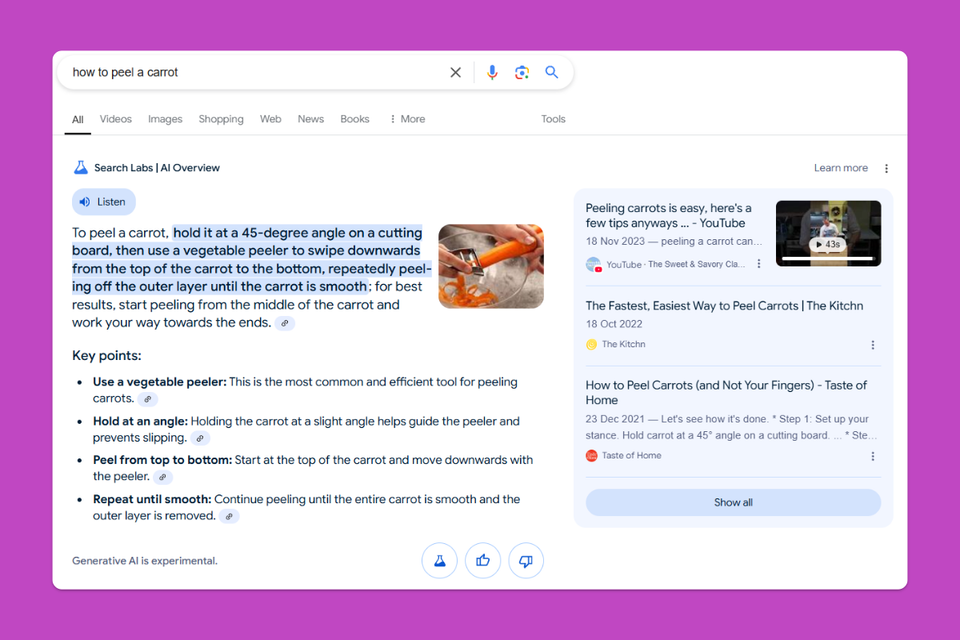
The text includes links to the sources the AI curated its content from.
This simple answer saves the user time by giving them exactly what they searched for, instead of making them read a long 2,000-word article.
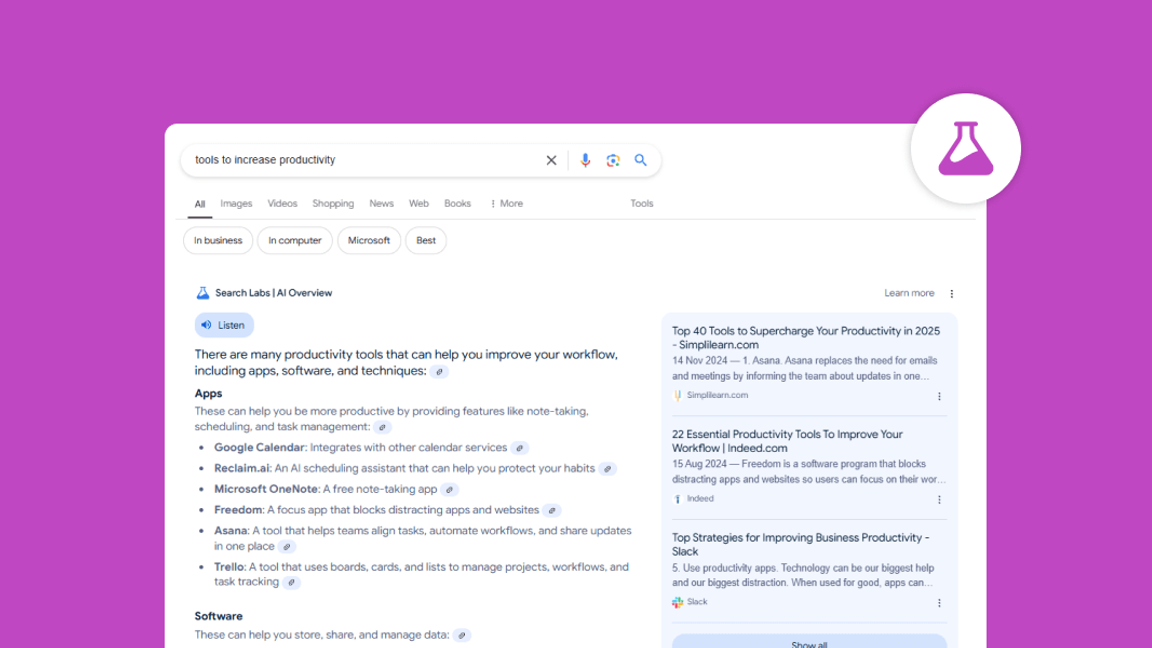
Here's another example of Google's SGE for the query "tools to increase productivity".
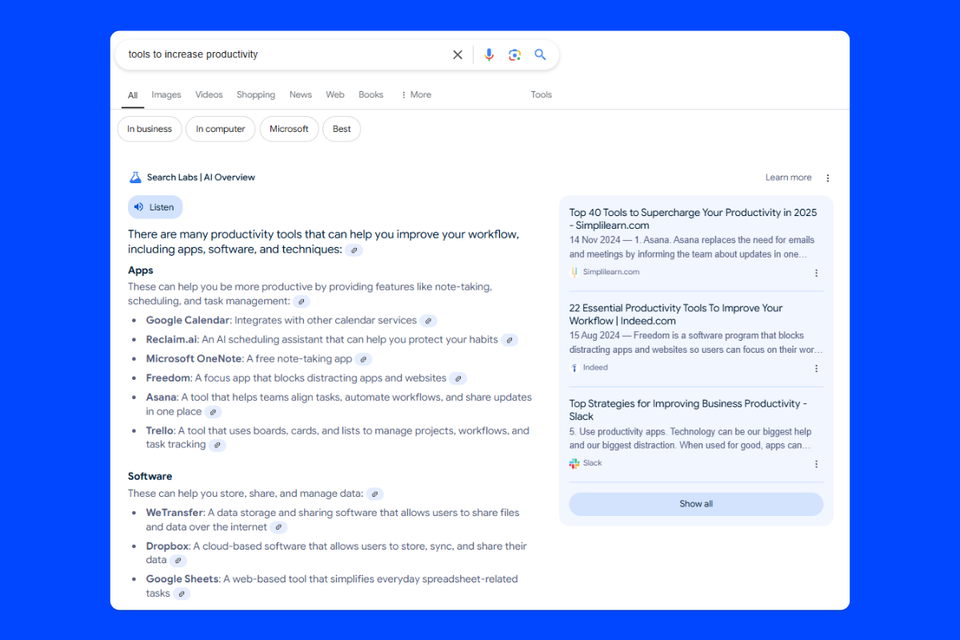
Here, the AI curates a comprehensive list of apps and software by analysing multiple articles and summarising the opinions of various experts and users.
What makes SGE so effective is its ability to sift through countless sources and deliver concise, actionable insights, saving users the hassle of manually working through multiple articles.
Instead of browsing endless pages, you get a well-rounded summary of the best tools, complete with key features and benefits, all in one place.
This shows that SGE isn't just pulling information. It's actively interpreting it, offering clear, precise recommendations tailored to your query.
Why Are AI Overviews Important for Your Website?
AI Overviews help your website get noticed. Here's how:
Increased Visibility
AI Overviews feature content from various sources, often linking directly to websites that provide useful, high-quality answers.
If your content is included, your site becomes more visible to users looking for quick, relevant answers.
A featured website gains prime real estate on the search page, making it more likely that users will notice your content.
Higher Click-Through Potential
Google reports that pages linked in AI Overviews often get more clicks than traditional search result listings, because the feature highlights content that directly answers user queries.
Credibility and Authority
Appearing in an AI Overview signals that your website is a trusted, relevant source of information. This builds your brand's authority and encourages users to engage with your content over your competitors'.
What Are the Cons of Google's AI Overviews?
Reduced Website Traffic
AI Overviews often provide direct answers, reducing the need for users to click through to linked websites.
This can hurt websites that rely heavily on organic traffic for revenue.
Loss of Content Attribution
AI Overviews aggregate data from multiple sources and sometimes fail to give proper credit.
That lack of visibility can affect smaller websites' authority and recognition.
Impact on Ad-Based Revenue Models
Because AI Overviews reduce the need to visit websites, they directly cut ad impressions.
That drop in traffic hits businesses that rely on ads for revenue.
Decline in CTRs and Ad Engagement
Google search ads outside the AI Overviews can easily be ignored, leading to fewer clicks.
This reduces ROI for advertisers and significantly limits ad visibility.
The Impact of Google AI Overviews on Search and Traffic Trends
Google's AI Overviews are changing the way we experience search, shaping how people interact with results and how businesses fight for attention online. This infographic breaks down the big trends, showing how AI Overviews affect rankings, stand out in industries like healthcare and even influence ad placements.
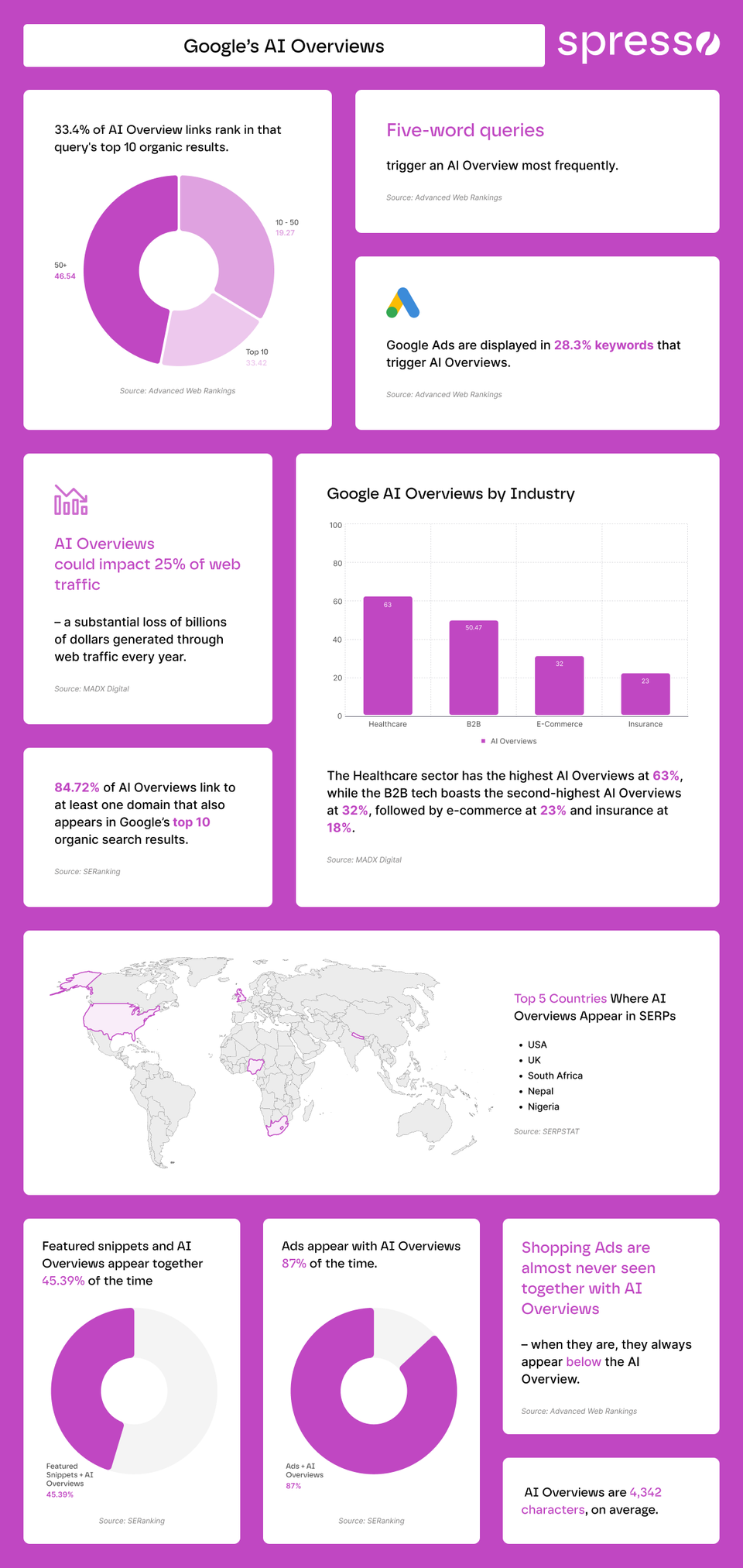
Embed this infographic on your website:
<p><strong>Infographic by <a href="https://www.spressostudio.com/">Spresso Studio</a>.</strong></p>
<p><a href="https://www.spressostudio.com/blog/how-to-optimize-your-website-for-ai-overviews">
<img src="https://cdn.prod.website-files.com/65549d817ea6c10d95cd4396/67569ff9ae3a03102cdab533_67569f5ec4990d749c736fa8_Google%2520Ads%2520Bidding%2520Strategy%2520(2).png" alt="Google AI Overview Infographic" width="1200"  /></a></p>
How to Optimise for AI Overviews
Fine-tuning your content for Google is a smart approach to AI Overview optimisation.
Here are some things you can do:
Structure Your Content for AI Readability
Proper headings like H1, H2 and H3 organise content hierarchically. This structure helps AI systems understand the main topics and subtopics, so key points are recognised and highlighted.
Structuring key information as numbered or bulleted lists helps AI extract concise insights, which are often preferred for summarisation.
Presenting data visually in tables and charts can also make content more appealing to AI, as these formats provide structured, clear information that's ideal for overviews.
Provide Authoritative and Credible Content
Building trust means focusing on E-E-A-T: Experience, Expertise, Authoritativeness and Trustworthiness.
Your content should be well researched, cite credible sources and reflect a deep understanding of the topic.
Show your expertise with case studies, industry statistics or unique insights that add value and set your content apart.
This approach builds trust with users and aligns with the AI's preference for high-quality, factually accurate information.
Optimise Metadata and Snippets
Write clear, concise meta descriptions that summarise your page's content and match what users are searching for.
Use structured data, like schema markup, to help AI identify and feature specific content such as FAQs, step-by-step guides, reviews or product details.
Create impactful titles by keeping them short but informative, so they reflect the primary topic and grab the attention of both users and AI systems.
Match Search Intent
AI-generated results are designed to give users instant, accurate answers to their queries.
To improve your chances of being featured, create content that directly aligns with what users are searching for.
Focus on the "why" behind a search, whether users want answers, tutorials, comparisons or reviews, and create your content accordingly.
Build Backlinks and Internal Links
Earning high-quality backlinks from authoritative sites can significantly improve your domain authority, which makes AI more likely to select your website for overviews.
These backlinks act as trust signals, telling AI that your content is credible and worth featuring.
Internal linking, on the other hand, helps AI understand the context of your site by connecting related content.
Strategically linking articles, blog posts and pages within your website makes it easier for AI to navigate and understand your content's overall structure and relevance.
AI Overviews: Boon or Bane for the SEO Industry?
The rise of AI-generated overviews in Google Search has sparked debate in the SEO industry, leaving marketers and content creators grappling with whether they're a benefit or a threat.
Google claims AI Overviews generate more clicks to websites by including links within the summaries. These links are prominently displayed, making it easier for users to discover valuable sources without scrolling through long lists of results.
Another positive is that websites featured in AI Overviews are seen as authoritative. That spotlight can boost brand credibility, attracting not just clicks but trust.
On the flip side, AI Overviews aggregate data from multiple sources, which reduces content attribution and dilutes the visibility of individual contributors.
As a result, website owners get fewer clicks, which is the opposite of what Google claims.
AI Overviews are a double-edged sword, bringing both opportunities and challenges for website optimisation.
Final Thoughts
AI Overviews are undeniably reshaping the SEO landscape.
They offer increased visibility, authority and the potential for higher click-through rates, but they also risk reducing direct traffic and content attribution.
To optimise for AI Overviews, make sure your content is well structured, credible and directly aligned with user intent.
Striking the right balance between gaining exposure through AI Overviews and keeping control over your content's attribution will be key to navigating this new era of search optimisation.