I log into a lot of ad accounts every week. Lately, almost every time I open one, something has changed that nobody asked for.
A new asset I didn't write. A campaign that got "upgraded". A static image that is suddenly a video.
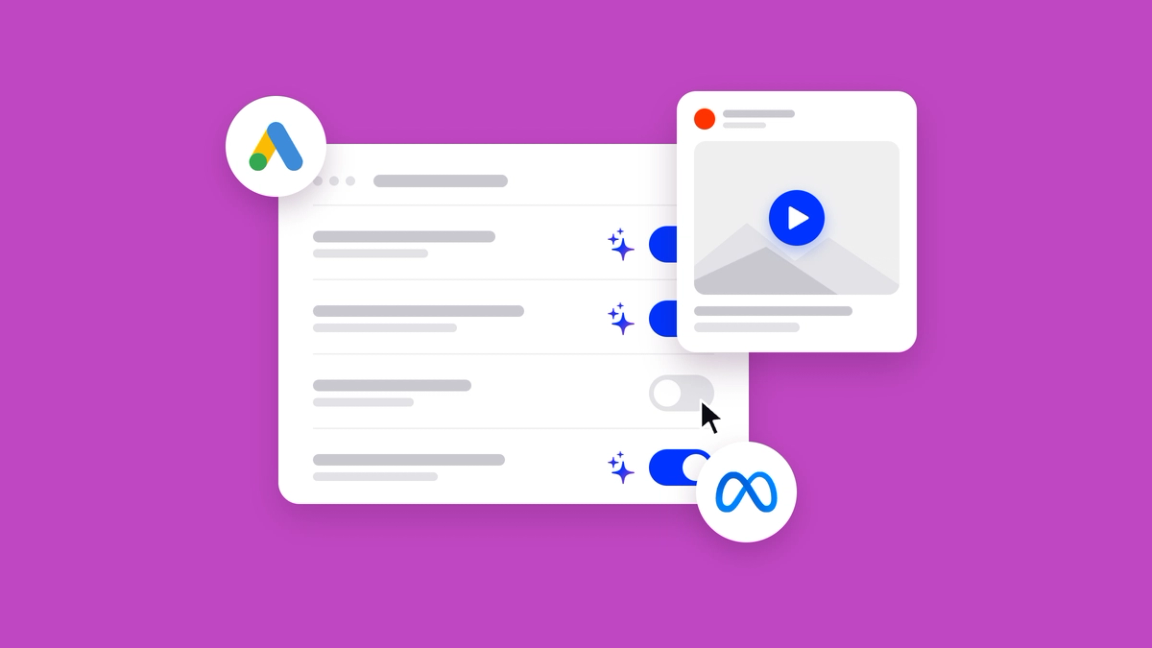
That's the real story of 2026 in paid ads. Google and Meta used to ask you to opt in to their AI features. Now they just turn them on, and you have to go and find the off switch.
Some of these changes are genuinely good. Some can quietly burn your budget or put words in your ads you would never sign off on. So I pulled together the 12 Google Ads updates and Meta Ads updates I think matter most right now, what each one actually does, and what I'd do about it.
| # | Update | Platform | On by default? |
|---|---|---|---|
| 1 | Promotions pulled from your website into your ads | Yes | |
| 2 | AI Max upgrades and the end of Dynamic Search Ads | Yes, for upgraded campaigns | |
| 3 | AI campaign localization (auto-translated campaigns) | No, beta | |
| 4 | Language targeting removed from Search | Automatic | |
| 5 | Ads in AI Overviews and AI Mode | Automatic, no opt-out | |
| 6 | New Performance Max controls | No, you set them up | |
| 7 | Customer lists auto-enrolled and auto-labelled | Yes, if eligible | |
| 8 | Local Services Ads moving into Google Ads | Mandatory migration | |
| 9 | Static images turned into video | Meta | Often pre-ticked |
| 10 | Advantage+ becomes the default setup | Meta | Yes |
| 11 | Click attribution counts link clicks only | Meta | Automatic |
| 12 | Threads ads go global, WhatsApp Status ads roll out | Meta | Threads on in Advantage+ placements |
Google Ads updates
Most of the Google Ads AI changes this year push in one direction. Less manual control, more Google deciding for you. Here are the eight I'd look at first.
1. Google now pulls promotions from your website into your ads
This one started on 12 October 2026, and it's on by default.
Google Ads will scan your website for deals, coupons and offers, turn them into promotion assets, and attach them to your campaigns. You don't build anything. You don't approve anything. For now it applies to Search and Performance Max campaigns that use location assets and don't already have a promotion asset.
On paper, that's handy. In real life, I've seen enough websites to know what's sitting on old landing pages. Expired Black Friday banners. A "first visit 20% off" deal that ended last year. An offer that only applies to one store.
Google might find all of that and advertise it.
2. Google Ads AI Max: your Search campaigns may already be upgraded
AI Max for Search came out of beta in April. Then Google started upgrading campaigns automatically.
If your Search campaign used automatically created assets or the campaign-level broad match setting, it was likely moved to AI Max during September 2026. Dynamic search ads are next. Google says those get upgraded from February 2027, and the option to create new ones is expected to disappear just before that.
AI Max is really three things bundled together:
- Search term matching. Broad-match-style expansion of the searches you show for.
- Text customization. Google writes headlines and descriptions using your landing page.
- Final URL expansion. Google picks which page on your site to send people to.
Google claims advertisers using the full set see about 7% more conversions at a similar cost. Maybe. That's Google's own data, so I'd treat it like any vendor claim.
My worry with AI Max for Search is simple. On a small budget, broader matching can spend money fast on searches you'd never pick yourself. And final URL expansion can send paid clicks to your blog or your careers page.
The good news is Google added a few things in October. You can now preview up to 10 AI-written headlines and descriptions before switching text customization on. There are also new reporting columns for brand inclusions, locations of interest and optimized targeting.
3. Google can now translate your whole campaign into another language
This is the auto-translation one, and it's in beta.
Google Ads is testing a tool called AI campaign localization. You pick a Search campaign, pick a new language, and Google translates the headlines, descriptions, sitelinks, callouts and keywords. It can even translate your landing page for visitors using a small piece of Google code.
It creates a brand new campaign and leaves it paused, so nothing goes live without you. You see the original, the translation and an English back-translation side by side, which is a nice touch.
Right now it only works from US English campaigns. Target languages include French, German, Spanish, Italian, Dutch, Polish and Portuguese, with more promised by the end of the year.
4. The language setting is gone from Search campaigns
This is separate from number 3, and people mix them up.
Since September 2026, Search campaigns no longer have a language setting. That includes the Search part of Performance Max. Google now decides which language to show your ad in based on the language your ad is written in, plus what it knows about the person searching.
Google also says multilingual users might see ads in a different language from the one they searched in, if Google thinks they'll understand it.
For most single-language advertisers, nothing much changes. If you run campaigns in two or three languages, it matters a lot.
5. AI Overview ads are live, and AI Mode ads are coming
Ads can now show inside Google's AI Overviews, the AI summary at the top of many searches. Google lists 12 countries where this works in English, on mobile and desktop. Ads above and below AI Overviews can show anywhere AI Overviews exist.
You don't need a new campaign type. Your existing Search, Shopping and Performance Max campaigns are eligible. But there's no opt-out, you can't target the placement, and you don't get a separate report for it.
Google also announced two new formats for AI Mode at Google Marketing Live in May. They're called Conversational Discovery ads and Highlighted Answers, and they're still being tested.
6. Google Ads Performance Max finally gives you some control back
Performance Max used to be a black box. You put money in, results came out, and you had no idea why.
That's slowly changing. Over the last year Google has added:
- Campaign-level negative keywords (up to 10,000 per campaign)
- Brand exclusions
- A channel report showing spend across Search, YouTube, Display, Discover, Gmail and Maps
- A better search terms report
- And as of October, A/B testing for asset groups
None of these are on by default. You have to set them up. If you don't, nothing protects you.
7. Your customer lists are being auto-enrolled and labelled
This one is quiet but important.
If you use both Enhanced Conversions and Customer Match in Google Ads, Google started auto-enabling something called conversion-based customer lists. Data processing began on 18 August 2026. Google also started labelling unclassified lists as "new" or "existing" customers on its own.
Why should you care? Because those labels feed into new customer bidding. If Google files a returning customer as new, you could end up paying a premium to win someone you already have.
8. Local Services Ads are moving into Google Ads
Google is retiring the separate Local Services Ads dashboard. LSAs are moving into Google Ads as a special Performance Max campaign that's still charged per lead.
The ads stay keywordless and still show on Search and Maps. But manual max-per-lead bidding goes away, and automated bidding takes over. There are also reports that some missed calls during business hours can be charged as leads.
The migration started in the US in August 2026. Other countries are reported for 2027, but Google hasn't confirmed dates.
Meta Ads updates
On the Meta side, the theme is the same. More AI ads, more automation, fewer manual levers. If you run Facebook and Instagram ads, every Facebook ads update below will touch your account in some way.
9. Meta is turning your static images into videos
At Advertising Week New York on 6 October 2026, Meta made "generate video from static images" generally available inside Advantage+ creative. You upload a still image. Meta adds motion and turns it into a short video ad.
I get why. Meta has said people spend more than 60% of their time on Facebook and Instagram watching video. If you only have static creative, you're missing a lot of Reels and Stories inventory.
Meta also expanded Ads Creative Studio, where you can change hooks, adjust audio and clip length, add captions and swap end scenes.
Here's the part that annoys me. Meta's help pages describe these creative enhancements as optional. But plenty of advertisers, me included, have seen them show up already ticked. So you can easily end up with an animated version of your ad that you never saw before it went live.
Sometimes that's fine. Sometimes it warps your product, stretches the image, or makes a serious brand look gimmicky.
10. Meta Advantage+ is now the default way to build campaigns
Early in 2026, Meta merged manual and Advantage+ campaign setup into one flow. Sales, App and Leads campaigns now start with an automation-first setup.
A campaign counts as Advantage+ when three things are on: Advantage+ campaign budget, Advantage+ audience and Advantage+ placements. Narrow any one of them and you lose the Advantage+ label for that part. Advantage+ shopping campaigns are now called Advantage+ sales campaigns, and they finally support multiple ad sets and audience exclusions.
This isn't bad. Meta's automation is genuinely good at finding buyers. But when everything is automatic, it's easy to forget the basics, like excluding people who already bought from you.
11. Facebook attribution changed, and your ROAS might look worse
This is the one I'd explain to every client before they panic.
On 3 March 2026, Meta changed what counts as a click for website and in-store conversions. Click-through attribution now only includes link clicks. Likes, comments, shares and saves moved into a new one-day "engage-through" window. Meta also cut the engaged-view window for video from 10 seconds to 5.
12. Threads ads go global and WhatsApp Status gets ads
In January 2026, Meta rolled out Threads ads to all users worldwide. If you use Advantage+ placements, Threads is already included by default. Reports also say businesses can now run Threads ads without needing a matching Instagram account.
Meta is also rolling out ads in WhatsApp Status, the Updates tab. It's not in every country yet, but it's getting there.
Threads inventory is often cheaper, which can be good news. It can also be a place where your budget goes without you noticing.
What's coming next
These aren't things you can switch on today, but they tell you where Google and Meta are heading.
- Google's AI Brief. A place to tell AI Max about your brand, your tone and what to avoid, in plain language.
- Google's Asset Studio. Image and video generation with Gemini, built right into Google Ads.
- AI Mode ad formats. Conversational Discovery ads and Highlighted Answers, still in testing.
- Meta's AI business assistant. Meta is testing a version that can generate creative, change targeting and adjust budgets when you ask it to in a chat.
- Fully automated Meta ads. The Wall Street Journal reported in 2025 that Meta wants brands to be able to create and target a full campaign from just a product image and a budget by the end of 2026. Meta hasn't launched this, so treat it as a plan, not a product.
If you're wondering where all this ends up, I think it's pretty clear. The platforms want to run the whole thing. Your job shifts from pulling levers to setting guardrails and checking the work.
Your 10-minute ad account checklist
If you do nothing else after reading this, do these ten things. Most take a minute each.
- Check Automated Promotions in Google Ads and turn it off, or add your own promotion assets.
- Remove expired offers from your website.
- Open every Search campaign and see if it was upgraded to AI Max.
- Preview AI-written copy before you keep text customization on.
- Add URL exclusions so paid clicks never land on your blog, careers or policy pages.
- Make sure each Search campaign is fully in one language.
- Add brand exclusions and a basic negative list to Performance Max.
- Check the customer type on your conversion-based customer lists.
- Review Advantage+ creative enhancements on every Meta ad, including duplicates.
- Add Meta's new attribution columns and note the 3 March change on your reports.
None of these Google Ads updates or Meta changes are going away. The platforms will keep adding AI, and they'll keep switching it on by default. That's fine, as long as you know what's running in your account and you've decided it should be.
If you'd rather have someone else go through it, that's literally what we do at Spresso Studio. We'll audit your Google Ads and Meta Ads setup, flag what's been switched on behind your back, and tell you what's worth keeping.