You've probably heard this one before. If you're getting something for free, you're the product.
I've always thought it was a bit dramatic, honestly. But every now and then a company does something that makes the saying feel very real. This week, that company was Google.
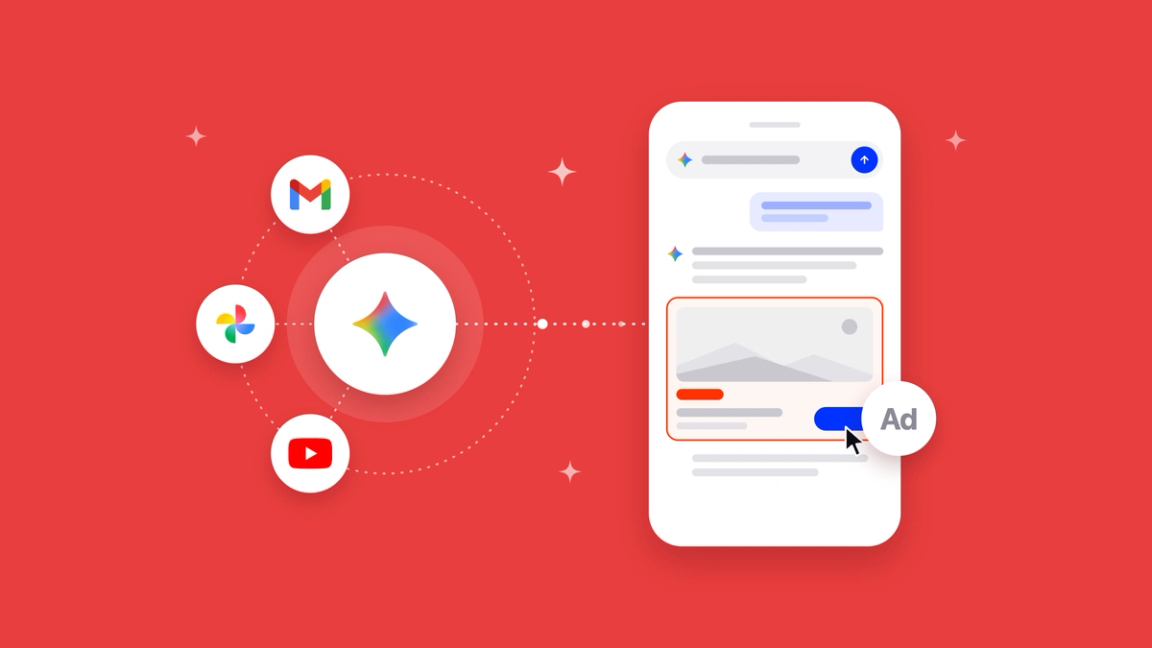
On October 16, Google confirmed it's started testing ads in AI Mode for people who use Personal Intelligence. That's the feature where AI Mode can look at your Gmail and Google Photos to give you more personal answers. And the funny part? Back in March, Google said these exact users wouldn't see ads.
So let's get into it. What Personal Intelligence actually is, what Google promised, what it's now doing, what it says it won't do, and the stuff it hasn't told us yet. And then my two cents, as someone who uses Google every day and also spends a lot of my working week running Google Ads for clients.
First, what is Personal Intelligence?
The simplest way I can put it: it's Google's AI, but it knows you.
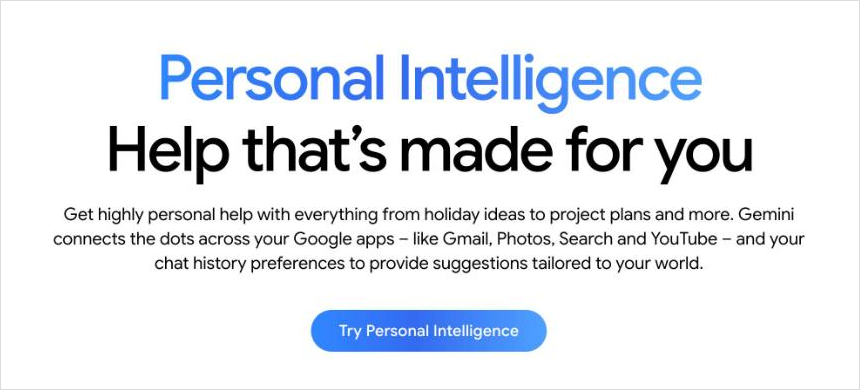
Source: Google Gemini, Personal Intelligence
Think of a good barista at your local cafe. A new barista asks what you want. A good one sees you walk in and already knows it's a flat white, extra hot, and that you're probably in a rush because it's Monday. That's the gap Google is trying to close between a normal search and a personal one.
It shows up in two places, and they work slightly differently.
In Gemini, Personal Intelligence connects the dots across your Google apps like Gmail, Photos, Search and YouTube, plus your past chats, to tailor its suggestions.
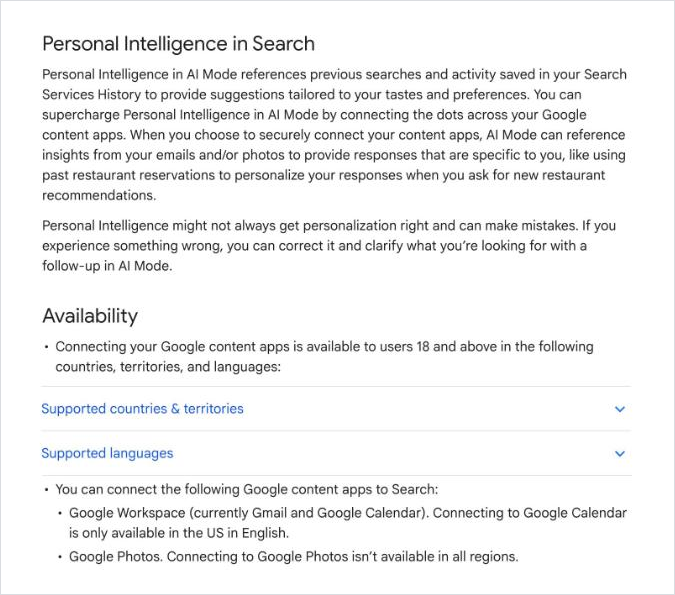
In AI Mode in Google Search, it uses your search history to start with. Then if you choose to connect your content apps, it can also reference insights from your emails and photos. Google's own example is pretty relatable actually. You ask for restaurant recommendations, and it uses your past restaurant bookings to figure out what you'd like.
Source: Google Search Help
Who can actually use it?
This is where it gets a bit messy, because the rules depend on where you're using it.
For Gemini, Google says Personal Intelligence is rolling out as a beta to eligible users globally, except in the European Economic Area, Switzerland, the UK and Nigeria. You need to be over 18 and on a personal Google Account. If you're on a Workspace Business, Enterprise or Education account, you're out.
For AI Mode in Search, connecting your apps is available to users 18 and over in a long list of countries. That includes the US, Canada, India, Australia and a big chunk of Asia-Pacific, Latin America and Africa. The apps you can connect are Gmail and Google Calendar (Calendar is US-only and English-only for now) and Google Photos, which isn't available in every region.

Source: Google Gemini
One thing to keep in mind, it's still rolling out. I'm based in India, which is on the list, and I still don't have it on my account. So don't panic if you go looking and it's not there yet.
The promise Google made in March
On March 17, 2026, Google opened Personal Intelligence in AI Mode as a beta to everyone in the US. And on the same day, a Google spokesperson told Search Engine Land that people who connect their apps wouldn't see ads.

Source: Search Engine Land, March 17, 2026
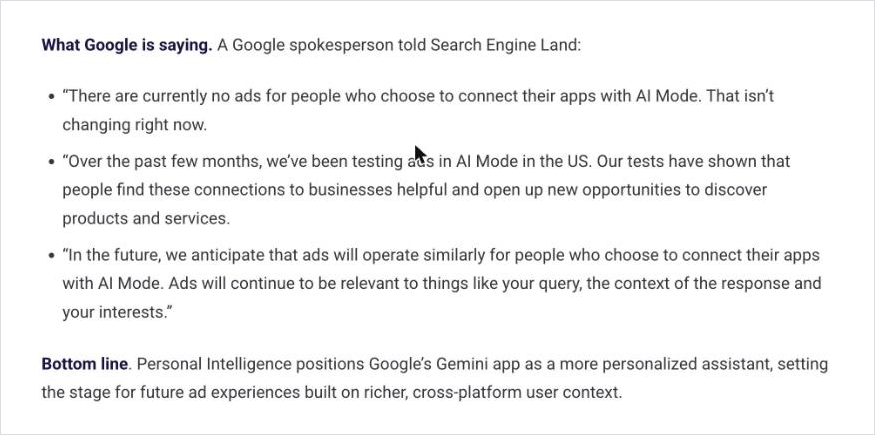
Their words were "There are currently no ads for people who choose to connect their apps with AI Mode. That isn't changing right now."
Notice the "right now" bit.
Because if you kept reading, the very next part of the statement pretty much told you where this was going. Google said that in the future, it anticipated ads "will operate similarly for people who choose to connect their apps with AI Mode."
Source: Search Engine Land, March 17, 2026
And then, the reversal: ads in AI Mode
Turns out "right now" meant about seven months.
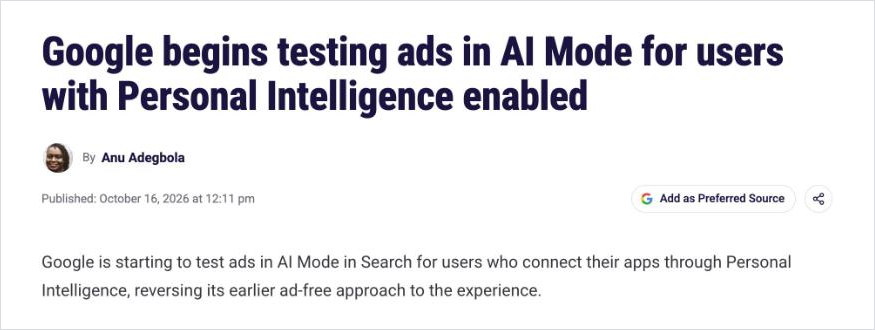
On October 16, 2026, Google confirmed it's testing ads in AI Mode for users who connect their apps through Personal Intelligence. Search Engine Land described it as Google reversing its earlier ad-free approach, which is a pretty fair way of putting it.
Source: Search Engine Land, October 16, 2026
So what actually changed? The same insights from your connected apps that help personalise your answers can now help decide which ads you see. Google has also updated its privacy policy to explain how this works.
Let me make that a bit more real. Say you've got a flight booking to Bali sitting in your Gmail. You ask AI Mode for things to do in Ubud. Before, you'd get a personalised answer. Now, along with that answer, you might also see an ad for a villa, a travel insurance deal or a tour company. And the reason you're seeing it isn't only what you typed. It's also what Google figured out from your inbox.
Is that useful? Maybe. Is it a little bit creepy? Also maybe.
The privacy limits Google says are in place
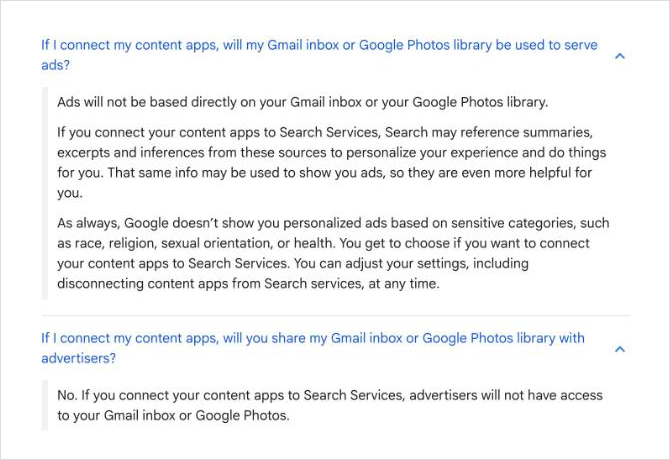
To be fair to Google, it's been fairly upfront on its help page. It actually answers the question most people would ask: will my Gmail inbox or Google Photos library be used to serve ads?
Here's the short version of what it says:
- Not directly from your inbox. Ads won't be based directly on your Gmail inbox or Google Photos library.
- But the inferences can be used. Search may use summaries, excerpts and inferences from those apps to personalise your experience, and Google says that "same info may be used to show you ads."
- No sensitive categories. Google says it doesn't personalise ads based on things like race, religion, sexual orientation or health.
- Advertisers don't see your stuff. Advertisers can't access your Gmail or Google Photos.
- It's opt-in. You choose to connect, and you can disconnect whenever you want.
Source: Google Search Help
That second point is the one I can't get past.
"Not directly from your inbox" sounds great on first read. But think about it like this. Imagine a friend promises they'll never read your diary out loud to anyone. Lovely. But they can still read it, take notes, and then tell people "oh, they're definitely planning a holiday and probably need new luggage." Technically they kept their promise. You'd still feel a bit weird about it, right?
That's kind of where summaries and inferences sit for me.
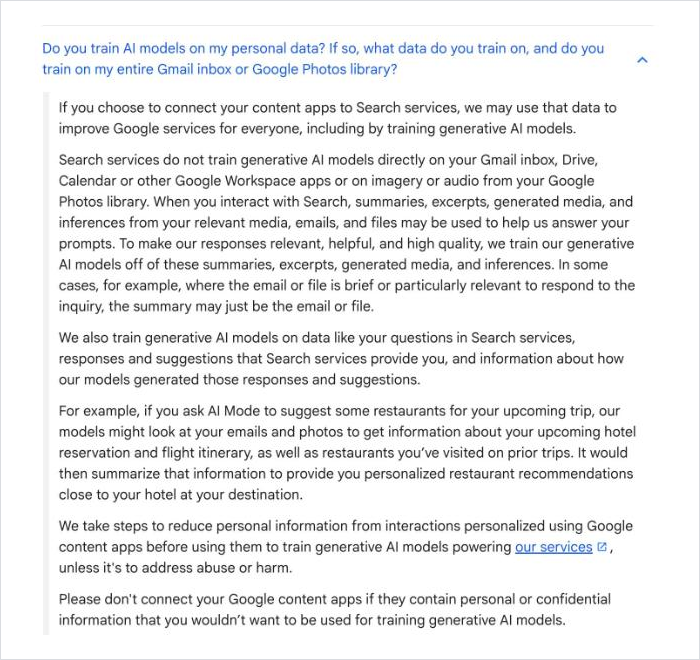
And it's not just ads. Google's help page also says that if you connect your apps, it may use that data to improve its services, including training its generative AI models on those summaries, excerpts and inferences. A subset of it can also be looked at by human reviewers.
Source: Google Search Help
Google's own advice here is honestly the most useful line on the whole page. Don't connect your apps if they have personal or confidential information you wouldn't want used to train its AI models. Which, for most of us, is... our inbox.
What Google hasn't told us yet
For something this big, there's a lot that's still unclear.
- No new controls for advertisers. There's no way to target or avoid Personal Intelligence placements. Google hasn't announced any new advertiser controls or targeting options for this test.
- No reporting. Nothing yet on how, or if, these ads will show up separately in your Google Ads data.
- No rollout plan. It's a test. Google hasn't said which countries it's running in or when it might expand. For what it's worth, its earlier AI Mode ad tests ran in the US.
- No clarity on how far it goes. Google's help page talks about "Search services" as a whole, which includes Search, Discover, Maps, Shopping, Flights, Hotels, Translate and News. As The Keyword pointed out, Google hasn't said whether connected-app data shapes ads only in AI Mode or across those other places too.
That last one matters more than it sounds. If it's just AI Mode, fine, that's one corner of Google. If it's everywhere you use Google, that's a very different conversation.
So how does this affect you?
If you're a user
The upside is pretty simple. Your ads could get more relevant. If you've just booked a trip, seeing a decent hotel near where you're staying isn't the worst thing in the world.
But here's the thing. When you connected your apps, the deal was "give us your context, get better answers." Now the deal is "give us your context, get better answers, and also ads shaped by that context." You didn't really get asked about the second part. It just got added.
It's a bit like signing up for a free gym membership, and a few months later they start putting sponsored protein shakes in your locker based on what you've been lifting. Helpful? Sure, sometimes. But you'd probably want to be asked first.
If you're a marketer
On paper, this sounds like a dream. Ads that understand someone's actual life, not just the five words they typed. Better intent, better matching, better results.
In reality though, it's another black box. And if you've run ads in Google's newer AI placements, you'll know exactly what I mean.
Look at ads in AI Overviews, which have been around for a while now. Google Ads Help says you can't opt out of serving ads in AI Overviews, and there's no segmented reporting when your ads show there. They just get lumped in as "top ads."

Source: Google Ads Help
If Personal Intelligence ads follow the same pattern, your ads could end up in one of Google's most personal placements without you choosing it, and without you being able to tell how it performed. I covered how AI Max and broad match work in my recent Google and Meta Ads updates roundup.
So, is this good or bad?
Honestly? It was kind of obvious this was going to happen.
AI answers aren't cheap to run. Every question you ask costs Google real money in computing power. And Google is, at the end of the day, an ad company. Somebody has to pay for Personal Intelligence, and if it's not you with a subscription, it's going to be you with your attention and your data. Free was never really free.
So I'm not upset that ads showed up. What bugs me is that users don't get a proper choice.
My take as a user
Yes, I might get better recommendations. I'm not going to pretend that's not useful. But I'll always be a bit skeptical about what's being pulled from my apps, what's being summarised, what's being inferred, and how that ends up deciding the ads I see. "Not directly from your inbox" is a pretty thin line.
What I'd really like is for Google to just give people the option. Something like:
- Are you okay with your connected data being used to train Google's models?
- Are you okay with ads being personalised using that data?
- Or would you rather pay a subscription and skip all of it?
Let the user decide. That's it. That's the whole ask.
For now, until there's more clarity, I'm personally going to be disconnecting.
My take as a marketer
The lack of controls and reporting is a big turn-off for me.
Don't get me wrong. If I'm paying Google to run ads, I'm happy for them to be more targeted. That's literally the point. But if I can't say for sure where my results are coming from, and I don't have any control over where my ads show, I'm going to be careful.
We've been here before. Anyone who's run automated, AI-driven campaigns on Google or Meta has probably had that moment where you check the account and the budget's already gone, and you're scrolling through the reports trying to figure out where it went. Sometimes there's a good answer. Sometimes there just isn't one. I've had that conversation with clients, and it's not a fun one.
So adding another opaque placement into the mix, especially one built on people's personal data, isn't something I'm rushing into. I'd want to see real controls and real reporting first.
What I'd do right now
If you use Personal Intelligence:
- Go check your settings. In your Google Account, head to Search Services Personalization, then Additional Personal Intelligence, then Connected Content Apps. See what's actually connected.
- Ask yourself if the trade is worth it. Better answers in exchange for personalised ads and your data helping train Google's AI.
- If you're not comfortable with it, disconnect. Seriously, it takes a minute and you can always reconnect later.
If you run Google Ads:
- Know which campaigns could end up in AI Mode. Google has said Performance Max, Shopping, and broad match or AI Max Search campaigns are the ones eligible for its AI placements.
- Keep a closer eye on spend and search terms than usual. Look out for weird shifts you can't explain.
- Don't scale budgets into AI-heavy campaigns just yet. Wait and see what Google announces on reporting first.
This is still a test, and Google could change its mind. But the direction is pretty clear. AI answers are turning into ad space, and even the most personal version of Google search isn't going to be the exception.
I'd love to know where you land on this. Are you staying connected, or pulling the plug?